Much of the discussion about AI in communication focuses on what we can produce: texts, images, presentations and summaries. A recent breakfast at Norrsken made me think about what it could help us understand.
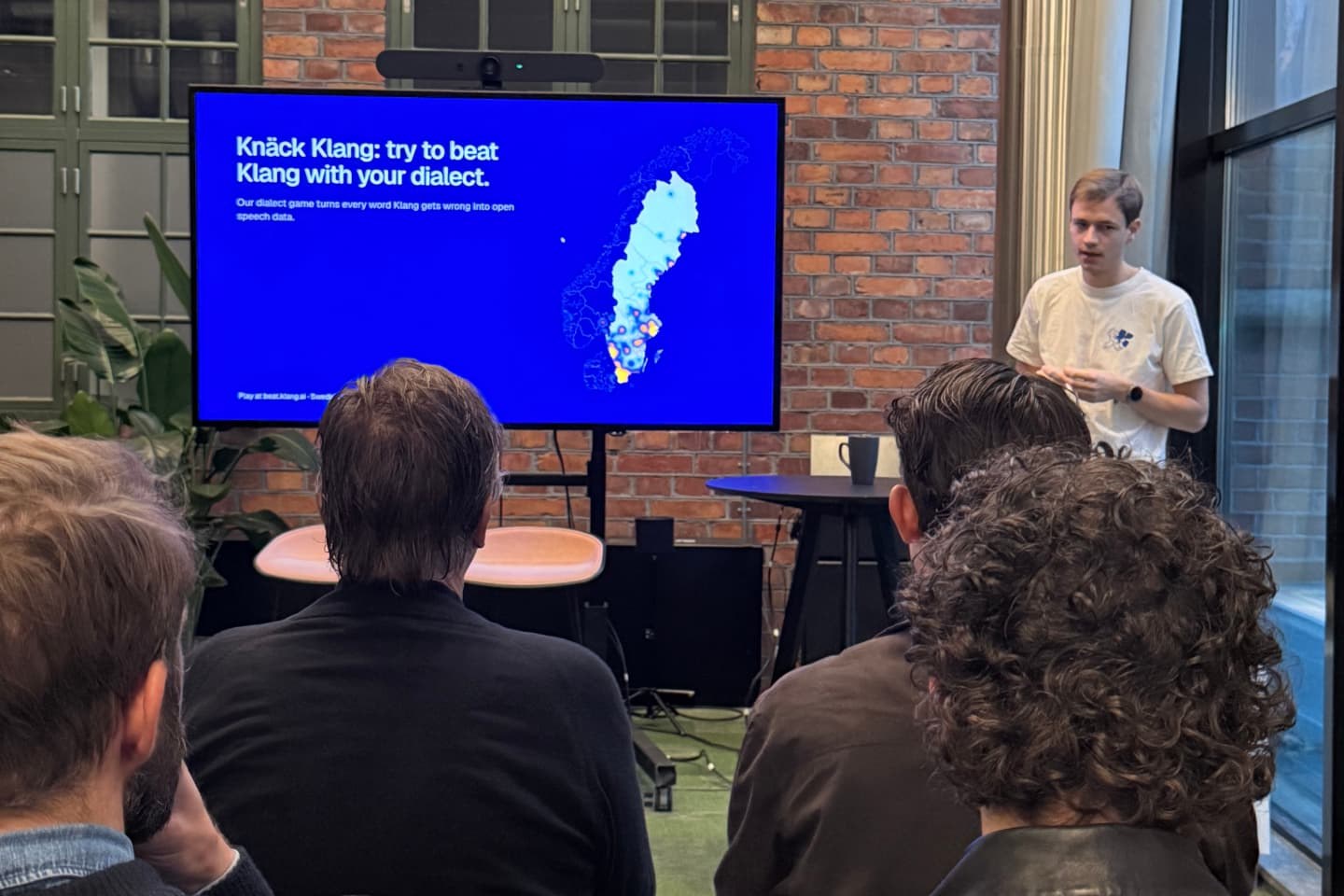
The event was hosted by Klang, which develops AI technology for working with speech. Its offering includes a platform and models that developers can use to build applications. At the breakfast, Jacob Andersson introduced Klang’s work with Swedish speech recognition and Pianissimo, before participants opened their laptops and began exploring what they could build.
I enjoyed that combination of introduction and experimentation. It made the technology feel accessible, while opening up questions relevant to my own work with communication, insights and evaluation. If spoken conversations become easier to capture and analyse, what could we learn about how communication works in practice?
First, can we trust what is captured?
One starting point is Klang’s work on Swedish dialects. Through the wider project Knäck Klang (Beat Klang), 1,800 prompts have been generated to test the technology.
Dialect recognition might initially sound like a technical detail. But if we want to use conversations as evidence, it affects whose contributions are represented accurately. A system that understands some ways of speaking better than others could introduce differences into the material before any analysis begins.
A misunderstood expression can change the meaning of a statement. When that statement is subsequently summarised, the original error may become harder to detect. We could end up drawing conclusions about someone’s views from words they did not actually use.
For those of us working with insights, this is a familiar methodological question: how does the way we collect information affect what we can conclude from it? Testing different dialects helps establish how well the technology represents the people whose speech it captures.

What could this reveal about communication?
With that foundation, there are interesting possibilities for evaluating our work.
Consider how employees describe their company. Communication teams develop positioning, values and messages, but understanding how useful those are in everyday conversations is harder. A brand presentation tells us what we intend to communicate. It tells us less about what happens when a colleague explains the business to a customer or a prospective employee.
In theory, analysing meeting summaries could help us investigate that gap. Which explanations recur? Where do people struggle? What questions keep coming back?
If employees consistently describe the business differently from the official positioning, that would be worth exploring. Perhaps our language is too abstract. Perhaps the positioning overlooks something customers care about. Colleagues may also have developed a clearer explanation through experience.
Those findings could inform the next iteration of the communication. We could revise an explanation, address a missing question or reconsider a claim, then assess whether the change helped.
For me, that is the compelling opportunity: bringing evaluation closer to the situations in which communication is used, so we can learn and develop it more continuously.
More information needs careful interpretation
Of course, similar language across meetings would not prove that a brand is understood or believed. Repetition may show that a message has reached employees. Understanding whether it helps them communicate requires further investigation, including the perspective of the people receiving it.
The purpose of the analysis matters, too. Learning from patterns across conversations is different from checking individual employees against an approved script. People should understand how their contributions will be used and have room to question the official language. Their alternative explanations could be precisely what we need to hear.
AI could make a larger body of material available for this work. We would still need to judge its quality, investigate the patterns and decide what the evidence supports. The value would come from the improvements those insights enable.
That was the connection I took away from the breakfast at Norrsken. Watching people start building prompted me to think about questions from my own field that this technology might help us explore. After years of working with communication and evaluation, I am curious about the possibility of following our work more closely into everyday conversations, learning where it helps and where we need to rethink it.